

Some mistakes are more expensive than others
Imagine one of your ancestors walking around thousands of years ago. They probably didn’t have comfortable shoes, health insurance or Uber Eats. Nada! Suddenly, something moves inside a bush and they think, That looks like a tiger. They panic, run away, probably look extremely dramatic in the process (totally understandable), and eventually discover that it was just a shadow or some leaves arranged in a particularly menacing way.
Fine. They wasted some energy and embarrassed themselves in front of whatever prehistoric friends were nearby, but they are still alive.
“Did you hear Dave got scared by a bush? What a fucking dweeb! Anyways, has anyone discovered fire yet? It’s freezing here.”

Now imagine the same situation again. Something moves in the bush and this time they think, It is probably a shadow. Except this time it actually is a tiger.
Well. The family story ends there.
“Did you hear Dave got mauled by a tiger? What a fucking dweeb! Anyways, that pile of leaves sure looks scary, I think I’ll avoid it!”

I’m not saying that’s exactly how it happened. It could’ve gone differently. I’m not an oldologist. This was a thought experiment, but it illustrates an important problem: different kinds of mistakes can have very different costs. Ask any crypto bro or skydiver and they’ll probably tell you the same.
Research on error management describes this kind of asymmetry: under uncertainty, false positives and false negatives can carry very different consequences, so a bias toward one kind of mistake can sometimes help avoid the more costly one (Johnson et al., 2013).
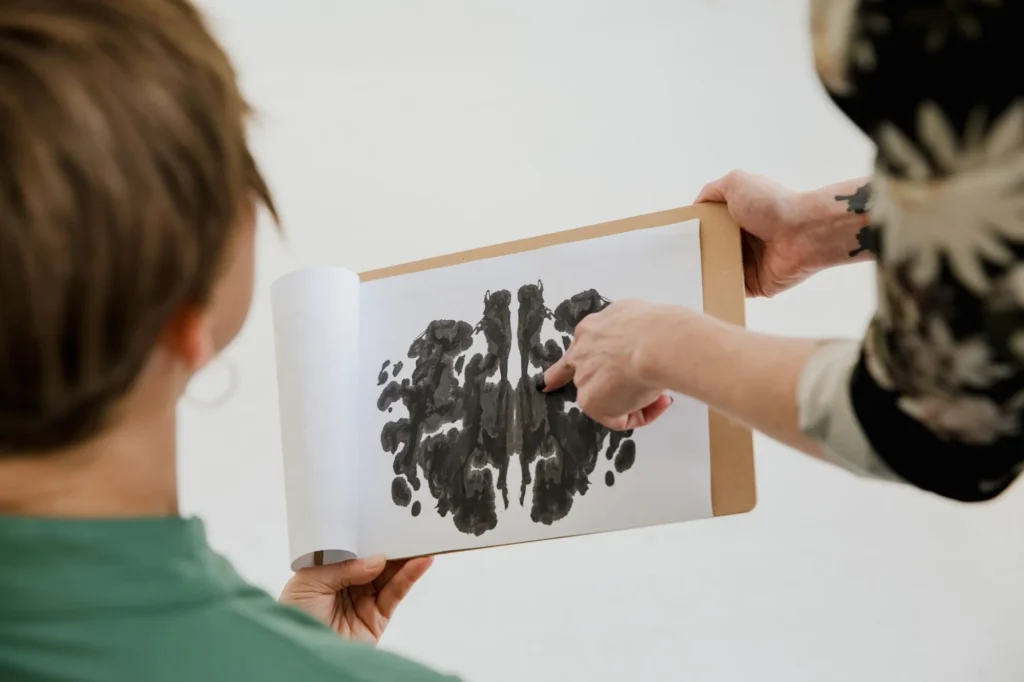
Why is there a face in my power outlet?
You have most likely seen this: a face in a cloud, a sad expression in a power outlet, the Virgin Mary in a piece of toast, or a demon sitting quietly on a chair at three in the morning.
Then you turn on the light and discover it’s just a pile of clothes. (Man, The Babadook really messed me up.)
This is pareidolia: perceiving familiar or meaningful forms in ambiguous stimuli (seeing faces and recognizable things where there technically aren’t any, basically). Face pareidolia has been studied experimentally, and our visual system appears particularly ready to interpret even weak face-like information as a face (Liu et al., 2014).
The brain receives incomplete information and basically says, “I can work with this.” It starts looking for shapes, intention, similarity and whatever else can help it make sense of what it is seeing.
“Here are some pictures of my parents screaming at each other.”
Faces are particularly good at grabbing our attention because we are highly sensitive to configurations that resemble eyes, a nose and a mouth (Liu et al., 2014). Give us a few dots and a line in approximately the right arrangement and suddenly an electrical socket looks disappointed in us for eating five bags of chips in the past hour.
(Fun fact: car manufacturers deliberately design “faces” in the front to influence different emotions. Just another way they manipulate your perception.) Research has found that people consistently attribute facial characteristics and personality traits to vehicle fronts, and manufacturers themselves describe features such as headlights and grilles in terms of a car’s “face,” expression and emotional character (BMW Group, 2012; Windhager et al., 2008).
Once you notice this tendency, it becomes difficult to stop seeing it. Cars have faces. Buildings have faces. Coffee stains become maps. Even the word OK looks like a person laying on their side. Your brain keeps volunteering those connections. Sometimes the result is useful, sometimes it is funny, and sometimes your chair becomes possessed until sunrise. (Seriously, watch The Babadook. Or don’t watch it, but know it may permanently change how you see a dark corner.)
A pattern is not automatically a cause
This distinction matters because pareidolia and magical thinking are different phenomena. Pareidolia involves perceiving a pattern in ambiguous information. Magical thinking can involve believing that thoughts, wishes or rituals influence events, while related causal illusions occur when people experience a causal relationship between events that are actually unrelated (American Psychological Association, n.d.; Matute et al., 2015).
Pareidolia is what makes you SEE a face on a piece of toast. Magical thinking is when the face-toast makes you THINK it’s lucky and grants wishes.
The difference becomes clearer as the interpretation grows. A shadow becomes a presence, a repetition becomes a sign, a shirt becomes an amulet, and a branch becomes divine permission to murder a Roman priest.
The interesting move happens when the mind goes from I noticed something to this means something, and sometimes further toward this thing affects that other thing. Those are different steps, even when they happen so quickly that they feel like a single experience.
Finding a face in a cloud does not mean you believe the cloud is communicating with you.
“Simba, you have forgotten who you are and so have forgotten me. Avenge meeeee.”
You can notice the pattern and stop there. Context, emotion and prior beliefs can influence what happens after that first moment of recognition.
(Go reclaim your throne, Simba. Listen to the cloud.)
Your brain hates an empty space
There is something uncomfortable about having no interpretation at all (existentialism is a thing after all). The stimulus is ambiguous, something unusual happened, or two events appear close together, and the mind starts looking for a structure that will make the situation easier to understand.
Faced with ambiguity, the brain starts looking for form, intention and cause. Most of the time, though, we’re perfectly capable of correcting ourselves. That monster was a pile of clothes. That mysterious sound was the refrigerator. Those dreams were just dreams.
Emotional importance can change how strongly an experience stays with us. Emotional events are often remembered more frequently and vividly than neutral ones (Kensinger & Ford, 2020). A random coincidence involving people you barely know might be forgotten in minutes or even ignored. The same kind of coincidence involving someone you love can feel etched into your memory forever.

“Remember when Dave screamed and pissed himself when he thought he saw a tiger in the bushes? Turns out he was right. Classic Dave! Love that guy. I’ll miss him for sure.”
Context matters too. The same ambiguous shape can look harmless during the afternoon and deeply supernatural when you wake up at three in the morning. Nothing in the pile of clothing changed.
We are extremely enthusiastic interpreters
The brain has to deal with a world without subtitles that explain everything. So we predict, compare, recognise, fill in the blanks, detect relationships and overexplain everything. Occasionally we get carried away. (You can make a religion out of this!)
I mean yeah, it’s a little silly to think that we see a power outlet and it looks like a face. But that can also lead to a much deeper thing when we see those connections through the lens of fear, hope, ritual, memory or belief.
The interesting question, then, is what happens after the pattern appears. Do we laugh at the face in the outlet? Do we investigate it? Do we ignore it? Do we give it meaning? Do we decide it is trying to tell us something?

WHAT ARE YOU TRYING TO TELL ME, POWER OUTLET? SPEAK, MY FRIEND! WHY WON’T THE THINGS WITH FACES RESPOND? HUH? WHAT’S THAT? BEHIND ME? THE BABADOOK IS BEHIND ME?! AHHHHHH WHY IS IT EVERYWHERE?!!
The mind can begin drawing invisible lines between things, and those lines can become surprisingly convincing. When unrelated events are repeatedly paired or interpreted together, people can develop genuine illusions of causal connection (Matute et al., 2015).
The human mind is incredible. And also just a little intense.
References
American Psychological Association. (n.d.). Magical thinking. In APA Dictionary of Psychology. Retrieved September 29, 2026, from https://dictionary.apa.org/magical-thinking
BMW Group. (2012, March 1). From the original to the original: The MINI design DNA. BMW Group PressClub USA. https://www.press.bmwgroup.com/usa/article/detail/T0125219EN_US/from-the-original-to-the-original-the-mini-design-dna
Johnson, D. D. P., Blumstein, D. T., Fowler, J. H., & Haselton, M. G. (2013). The evolution of error: Error management, cognitive constraints, and adaptive decision-making biases. Trends in Ecology & Evolution, 28(8), 474–481. https://doi.org/10.1016/j.tree.2013.05.014
Kensinger, E. A., & Ford, J. H. (2020). Retrieval of emotional events from memory. Annual Review of Psychology, 71, 251–272. https://doi.org/10.1146/annurev-psych-010419-051123
Liu, J., Li, J., Feng, L., Li, L., Tian, J., & Lee, K. (2014). Seeing Jesus in toast: Neural and behavioral correlates of face pareidolia. Cortex, 53, 60–77. https://doi.org/10.1016/j.cortex.2014.01.013
Matute, H., Blanco, F., Yarritu, I., Díaz-Lago, M., Vadillo, M. A., & Barberia, I. (2015). Illusions of causality: How they bias our everyday thinking and how they could be reduced. Frontiers in Psychology, 6, Article 888. https://doi.org/10.3389/fpsyg.2015.00888
Windhager, S., Slice, D. E., Schaefer, K., Oberzaucher, E., Thorstensen, T., & Grammer, K. (2008). Face to face: The perception of automotive designs. Human Nature, 19(4), 331–346. https://doi.org/10.1007/s12110-008-9047-z