
“I discovered at a very early age that if I talk long enough, I can make anything right or wrong. So either I’m God or truth is relative. In either case, booyah!”
Jeff Winger, Community (Quotes.net, n.d., “Jeff Winger” section).
My fascination with magic words began around the same time as my fascination with magicians snapping their fingers.
If you grew up with even the most basic manners, you probably learned two of the most important magic words there are: please and thank you.
Then a magician comes along, says “Abracadabra,” and makes everything much more confusing. Did the magic word change something? Are words capable of generating change in the real world?
Obviously they can. Otherwise politicians would starve and lawyers would evaporate from existence.
Abracadabra, on prescription
Did you know Abracadabra could cure a fever? I strongly doubt it, but that didn’t stop Quintus Serenus from prescribing it.
In the medical poem Liber medicinalis, attributed to Serenus, the instructions were to write Abracadabra on a piece of paper, remove one letter on each new line, and wear it around your neck (Francese, 2013). It looked like this:
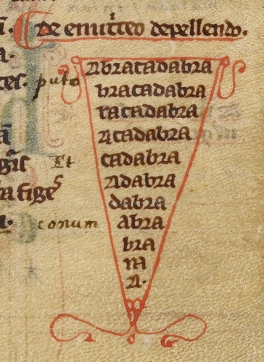
Detail cropped from a thirteenth-century manuscript showing the Abracadabra charm, Royal MS 12 E XXIII. Image: British Library, via Google Arts & Culture (British Library, n.d.).
As the word disappeared one letter at a time, the fever was supposed to disappear too.
Some old prescriptions make being a doctor sound like the easiest job ever: make shit up and pray for the best. Even Freud was writing enthusiastically about the medical uses of cocaine in 1884 (Freud, 1884).
So what does Abracadabra actually mean?
One popular explanation gives it an Aramaic origin and translates it as “I create as I speak.” As a magician, I really want that to be the answer.
Unfortunately, its origin is still uncertain. “I create as I speak” is one proposed explanation, and we still don’t know if it’s the right one (Harper, n.d.-a).
What the hell does Sator mean?
Then there’s this:
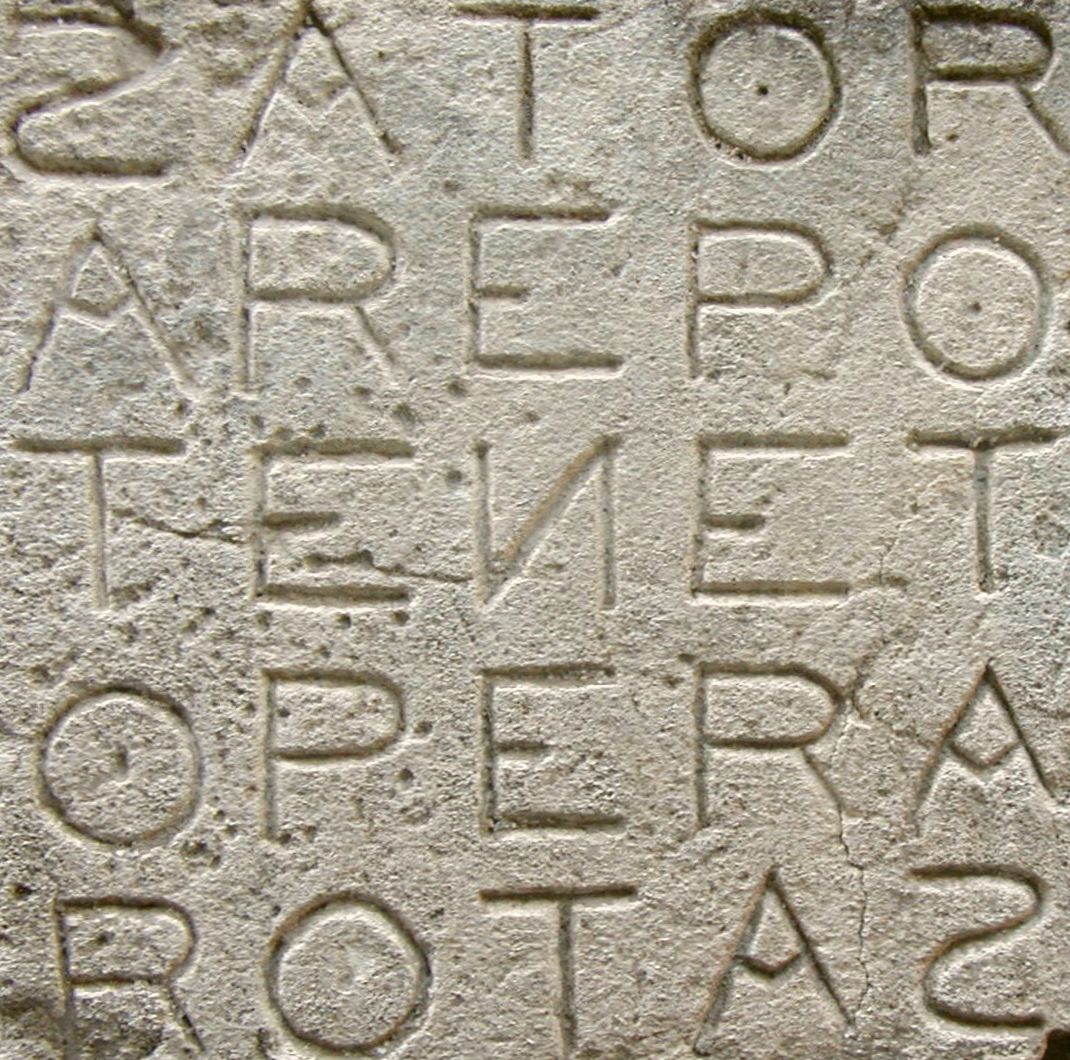
Sator square at Oppède, France. Photograph: M. Disdero (2003), CC BY-SA 3.0. Unmodified.

Read the rows, then read the columns. You get the same five words. Read the whole thing backwards and you’re back where you started.
A first-century example was found in Pompeii’s Great Palaestra (Parco Archeologico di Pompei, 2022). To this day, nobody knows for sure what the whole thing was meant to say or do (Fishwick, 1964). It could have been a cryptic message. For all we know, we’re staring at an ancient meme.
Either way, Christopher Nolan borrowed its words for Tenet: Sator, Arepo, the Rotas company, the opera, and the title itself (Nolan, n.d.). That guy has a fascination with magic words.
In Memento, Leonard tattoos words onto his body because he can’t rely on his memory. Those words tell him what to believe and what to do next. They’re practically spells for his future self (Nolan, 1999).
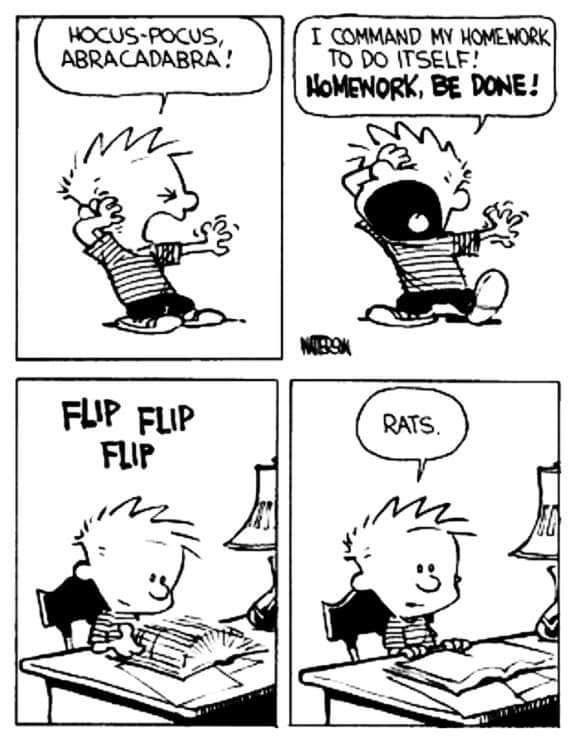
Calvin and Hobbes, by Bill Watterson (1986).
Trust me, Calvin. I’ve felt the same way.
What words can actually do
Spoken words are vibrations travelling through the air. Somehow, those vibrations can make someone laugh, cry, or feel what you’re feeling. They can change someone’s mind.
The tone matters too. Think about how we insult our closest friends. Some of the people we say the worst things to are people we’d give our lives for. They can hear the affection in how we say it.
And some words change things as soon as you say them. Say “I promise,” and now someone expects you to keep your word. Say “I bet you twenty bucks,” and, if they accept, you’ve made a bet.
The philosopher J. L. Austin studied how we do things by speaking. Promising, apologising, making a bet: in each case, saying the words is part of doing it. That’s what a “speech act” is (Longworth, 2025).
Writing takes this further. Someone can put an idea in your head without being in the room. They don’t even have to be alive. They just need you to read what they wrote (like Inception in real life, but you can actually understand it) (Nolan, 2010).
Learning to read opens up all those ideas. You can find out what other people thought and decide for yourself whether they were onto something or full of shit.
In older English, spell meant a story or something said. Later, it also came to mean a set of words believed to have magical power (Harper, n.d.-b).
Say what you mean, mean what you say
I used to use whatever generic magic word came to mind. Then I realised that sometimes I didn’t believe what I was saying. I could say the word, but I wasn’t feeling it, and I think other people could feel that too.
It’s a bit like Death Note: writing the name isn’t enough. You have to picture the person’s face (Ohba, 2005). With magic words, I feel I need to think about what I’m saying and visualise what I want to happen. Otherwise I’m just saying a word.
Silence is a powerful spell too. Stay quiet long enough and people often feel the need to break it. If you can resist that urge yourself, you start learning about timing and how to communicate without saying a word. Musicians, comedians and magicians work with that every day.
These days, I like asking people if they have a magic word.
I encourage the shit out of whatever they come up with. I congratulate them on their creativity. Sometimes on their lack of it. We have fun with it.
So, do you have a magic word?
And yes, “please” counts.
References
British Library. (n.d.). Quintus Serenus, Liber medicinalis [Manuscript description]. Google Arts & Culture. https://artsandculture.google.com/asset/quintus-serenus-liber-medicinalis/fAGBmLhWW99n0g?hl=en
Disdero, M. (2003, August 19). Sator square at Oppède [Photograph]. Wikimedia Commons. https://commons.wikimedia.org/wiki/File:Sator_Square_at_Opp%C3%A8de.jpg
Fishwick, D. (1964). On the origin of the Rotas-Sator square. Harvard Theological Review, 57(1), 39–53. https://doi.org/10.1017/S0017816000024858
Francese, C. (2013, May 13). Abracadabra (Serenus Sammonicus Lib. Med. 923–941). Latin Poetry Podcast. Dickinson College. https://blogs.dickinson.edu/latin-poetry-podcast/2013/05/13/abracadabra-serenus-sammonicus-lib-med-923-941/
Freud, S. (1884). Cocaine. The Medical News, 45(18), 502. https://www.freudedition.net/en/werke/cocaine/druckschrift
Harper, D. (n.d.-a). Abracadabra. In Online Etymology Dictionary. Retrieved October 21, 2026, from https://www.etymonline.com/word/abracadabra
Harper, D. (n.d.-b). Spell. In Online Etymology Dictionary. Retrieved October 21, 2026, from https://www.etymonline.com/word/spell
Longworth, G. (2025). John Langshaw Austin. In E. N. Zalta & U. Nodelman (Eds.), The Stanford Encyclopedia of Philosophy. Metaphysics Research Lab, Stanford University. https://plato.stanford.edu/entries/austin-jl/
Nolan, C. (n.d.). Tenet [Screenplay]. Script Slug. https://assets.scriptslug.com/live/pdf/scripts/tenet-2020.pdf
Nolan, C. (1999). Memento [Shooting script, final draft August 10, with revisions through October 4]. Script Slug. https://assets.scriptslug.com/live/pdf/scripts/memento-2000.pdf
Nolan, C. (Director). (2010). Inception [Film]. Warner Bros. Pictures; Legendary Pictures; Syncopy. https://www.warnerbros.com/movies/inception
Ohba, T. (2005). Death note: Vol. 1 (T. Obata, Illus.). VIZ Media. https://www.viz.com/manga-books/manga/death-note-volume-1-0/product/513
Parco Archeologico di Pompei. (2022, July 28). Il Quadrato del Sator dalla Palestra Grande. Pompeii Commitment. https://pompeiicommitment.org/il-quadrato-del-sator-dalla-palestra-grande/
Quotes.net. (n.d.). Community quotes [Jeff Winger quotation]. https://www.quotes.net/mquote/706766
Watterson, B. (1986, April 25). Calvin and Hobbes [Comic strip]. GoComics. https://www.gocomics.com/calvinandhobbes/1986/04/25