

I have always been fascinated by the story of the Rex Nemorensis. It is one of the weirdest stories in mythology.
Ancient Rome didn’t have LinkedIn, but apparently it did have branch managers.
Imagine you are a slave who has just escaped in ancient Rome. You have no Google Maps, no passport and no Plan B. People are looking for you and, let’s be honest, you are not getting very far through the forest in sandals.
Then you hear about a place: Lake Nemi.
Nemi. Different fish.
Near the lake stood a sacred sanctuary dedicated to Diana, goddess of hunting, fertility and abundance. A mystical, beautiful place with a completely normal rule for the ancient world.
By which I mean absolutely psychotic.
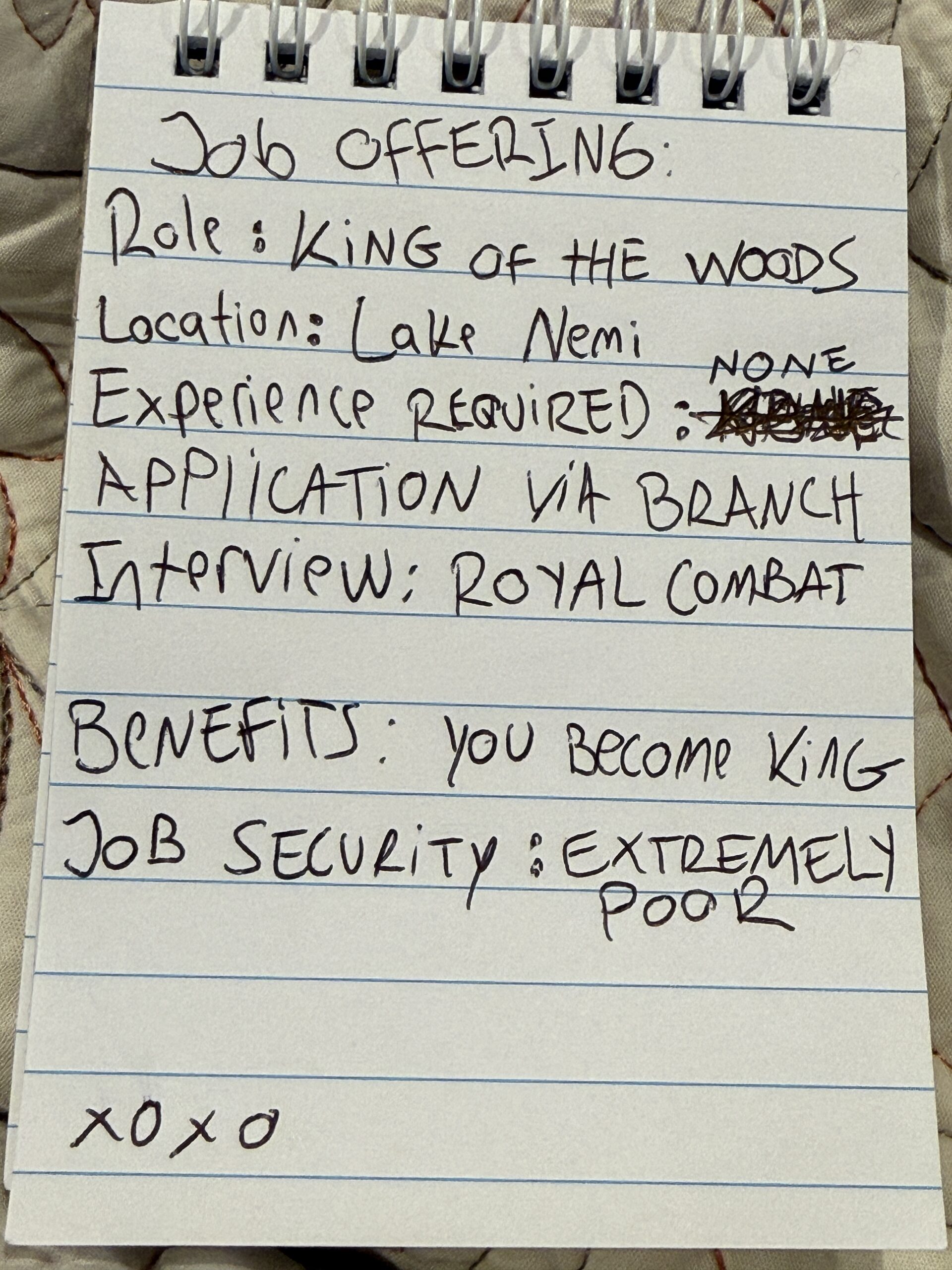
The sanctuary was guarded by the Rex Nemorensis, the King of the Wood. You could not get that title by sending in a résumé. To become the next Rex Nemorensis, you had to break a sacred branch from the grove and challenge the current king to a duel to the death.
Basically Black Panther, with more Roman trauma and a smaller Marvel budget.
If you won, congratulations: you were the new king.
Tiny detail. You now had to spend the rest of your life knowing that another fugitive could arrive at any moment, break another branch and try to kill you.
The most stressful career progression in history.
Why did any of this make sense?
The weirdness of the story is obvious. The more interesting question is the logic underneath it.
Why should breaking a branch give someone the right to challenge a king? Why should replacing that king matter beyond the grove? And why should the life of one man have anything to do with fertility, abundance or the natural world around him?
This is where James George Frazer enters the story.
Frazer, author of The Golden Bough, used the Rex Nemorensis as the opening to a much larger argument about magical thinking. He interpreted the Rex Nemorensis as a sacred figure whose vitality was symbolically tied to the fertility of the land and the wider natural order.
The logic worked something like this:
Ageing king → weakening land
New king → renewal
From the perspective of ordinary physical causation, the relationship is hard to defend. The health of an armed gentleman standing in a forest does not control the crops.
Within Frazer’s reading, however, the symbolic relationship carried causal weight.
King equals land.
Death equals renewal.
Sacred branch equals the right to power.
The king, the branch, the grove and the land start behaving like parts of the same symbolic system.
That is where this strange succession ritual starts becoming a story about magical thinking.
Sympathetic magic
Frazer used the term sympathetic magic for the idea that things can influence one another because they resemble each other or because they have previously been in contact.
He reduced that logic to two broad principles:
Like produces like.
Contact preserves connection.
The first is about resemblance. Something can act upon another thing because it looks like it, represents it or symbolically stands in for it.
The second is about contact. Things that were once connected may be treated as if some part of that relationship remains after they are separated.
This kind of logic appears in charms, relics, lucky objects, ritual practices and objects believed to retain something of a person, place or event. In Frazer’s framework, the visible objects matter because of the invisible relationships attached to them.
And suddenly the branch is doing a lot more work than a branch normally does.
It is wood, yes, and within the ritual it also becomes permission, challenge and transition. The king is a person whose role carries a symbolic connection to a wider natural order. The grove is a location structured by ritual, mythology and meaning.
The physical objects remain ordinary. The relationships around them change what they mean.
The logic changed clothes
These days, none of us are living in the forest of Nemi waiting for somebody to murder us over a branch.
Working life can feel a little like that, although that probably belongs in another article.
But the logic survived.
It simply changed clothes.
We still surround ourselves with objects whose importance goes far beyond their physical material. A photograph is paper or pixels, but it can feel deeply connected to the person or moment it represents. A wedding ring is metal, yet its significance comes from the history, promises and relationships attached to it. A flag is fabric and can still carry identity, history and belonging.
These examples do not all belong under the anthropological category of sympathetic magic. They do reveal something broader about how human beings use symbolic relationships.
We let an object stand for a person. A place can carry a memory. A symbol can represent an entire community. Something that touched an important event can become important because it was there.
Sometimes those relationships remain symbolic. Sometimes they become ritual. Sometimes they start to feel causal. And sometimes entire systems of behaviour grow around them.
Why the King of the Wood still matters
What keeps pulling me back to the Rex Nemorensis is how much of the whole system depends on connections nobody can actually see.
The king is connected to the land. The branch is connected to the right to challenge him. His death is connected to renewal. A person, an object, a place and an idea of natural order become woven together tightly enough that behaviour follows the symbolic structure.
Frazer looked at those relationships and interpreted them through his theory of magical thinking.
His reading came centuries later and reflects his own interpretive framework. The ancient sources do not give us direct access to what every participant in the cult believed. That uncertainty is worth keeping in view while we use the story to think about the kinds of connections humans are capable of creating.
And that is the part I find difficult to dismiss as something belonging only to ancient people, superstition or mythology.
We constantly connect things.
We give those connections meaning.
Sometimes the relationship becomes important enough that the invisible line between two things matters almost as much as the things themselves.
For the Rex Nemorensis, that line connected a branch, a king and a landscape.
Which is useful information to have before applying for the position.
If you want to explore another way of seeing how ideas connect, read How to Organize Your Creative Thoughts, a practical introduction to using Obsidian to connect ideas, research and creative projects.
References
Frazer, J. G. (1890). The golden bough: A study in comparative religion. Macmillan. https://en.wikisource.org/wiki/The_Golden_Bough_(1890)
Smith, W. (1890). Rex Nemorensis. In A dictionary of Greek and Roman antiquities. John Murray. https://www.perseus.tufts.edu/hopper/text?doc=Perseus%3Atext%3A1999.04.0063%3Aentry%3Drex-nemorensis-cn